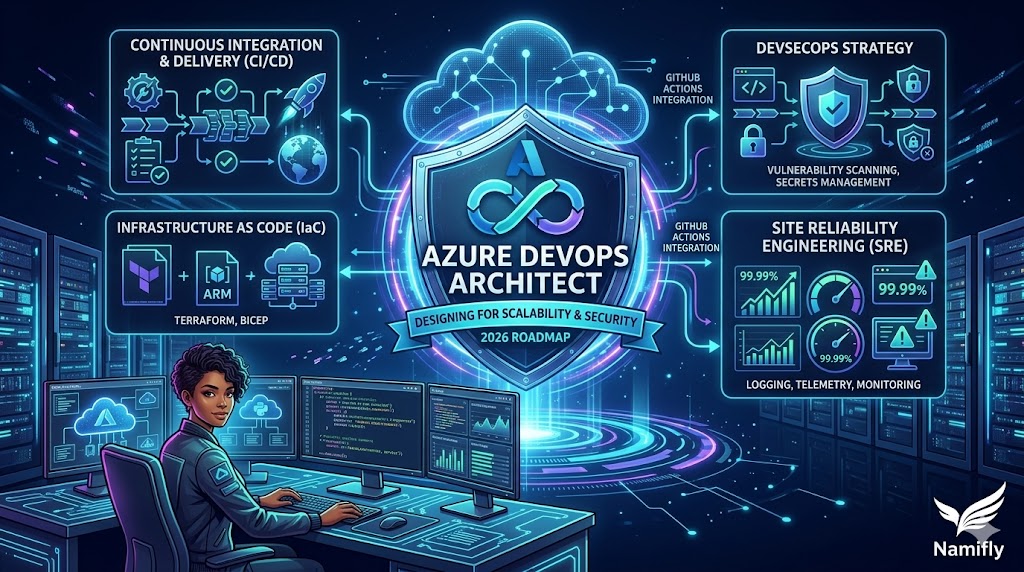
DevOps Architect 2026: Designing for Scalability, Security, and Architectural Excellence
In the rapidly evolving landscape of 2026, the term "DevOps" has transcended its original definition. It is no longer just a trend or a set of tools used by the operations team—it is the primary engine of business success. Every major enterprise, from fintech giants to healthcare innovators, relies on the speed and reliability of their deployment pipelines to stay competitive.
However, a frustrating paradox has emerged: many organizations have "implemented" DevOps, yet they still struggle with slow release cycles, frequent bugs, and system downtime. The reason is simple but profound: a lack of proper Design and Architecture. True DevOps isn't just about using tools; it’s about integrating technology, process, and culture into a unified, high-performing system. This is the core of "Designing and Implementing Microsoft DevOps Solutions."
1. Design First, Implement Later: The Architect’s Creed
The biggest mistake modern teams make is jumping into tools without a comprehensive blueprint. Many engineers start creating pipelines or spinning up virtual machines before they’ve answered the "How" and "Why." A true DevOps Architect plans from the ground up: how to reduce deployment costs, how to lower failure rates to near zero, and how to make the rollback process instantaneous if something goes wrong.
In 2026, Infrastructure as Code (IaC) is no longer optional; it is the absolute standard. If you are still manually clicking through a cloud portal to set up a server, you are practicing "Cloud Administration," not DevOps. As an Architect, you must master the efficient use of declarative tools like Azure Bicep or Terraform. By treating your infrastructure as software, you ensure that your environments are version-controlled, repeatable, and immune to human error.
2. DevSecOps: Security by Design, Not by Afterthought
In the past, security was the "final gate"—a checklist performed right before a release that often caused weeks of delays. In the modern era, that model is dead. Security can no longer be a final step.
As a DevOps Architect, you must adopt a "Security by Design" mindset. During the initial design phase, you must ask critical questions: How can we automate vulnerability detection within the code using Static (SAST) and Dynamic (DAST) analysis? How do we manage sensitive secrets and API keys without ever exposing them to the human eye? Master tools like Azure Key Vault and automated scanning are what separate a junior engineer from a Senior Architect. At Namifly, we teach you to bake security into the very DNA of your CI/CD pipelines.
3. Site Reliability Engineering (SRE): Engineering for 99.99% Uptime
Maintaining high availability in 2026 isn't a matter of luck or "hoping for the best." It is the result of rigorous Site Reliability Engineering (SRE) practices. An Architect designs systems that are self-healing. By implementing advanced SRE concepts, we create automated dashboards and telemetry systems that alert us to potential issues before they turn into outages.
We focus on the metrics that matter: Service Level Objectives (SLOs) and Error Budgets. Instead of just reacting to failures, you will learn to build resilient systems that can withstand high-pressure traffic spikes. This proactive approach ensures that your users enjoy a seamless experience while your team avoids the stress of midnight "firefighting" sessions.
4. The "Big Picture" Advantage: Why Students Choose Namifly
The internet is full of tutorials that show you how to use a specific tool. But knowing how to use a hammer doesn't make you an architect. Our students choose Namifly because we don't just teach the "how"; we teach the "Why." Many of our learners come to us having mastered the basics elsewhere, only to realize they lack the architectural vision required for senior roles. We focus on the Big Picture. You won't just learn the names of Azure tools; you will learn which strategy is best for a multi-cloud environment, how to manage cross-functional teams, and how to drive a culture of continuous improvement. This level of architectural expertise is the single biggest driver of career growth and high-salary placements in the current market.
🚀 Take the Next Step in Your Career
Ready to stop managing pipelines and start architecting them? If you are prepared to elevate your professional status and lead the next generation of cloud engineering, your journey begins here.
Check out our featured course: Designing and Implementing Microsoft DevOps Solutions (AZ-400) Course
For comprehensive architectural guidance, deep-dive technical labs, and a community of expert mentors, Namifly is your best partner.